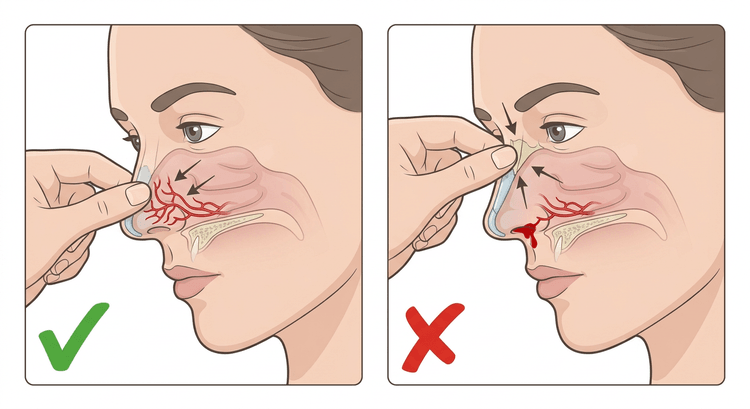
Almost all nosebleeds arise from Kiesselbach's plexus on the anterior septum and stop with correctly performed compression. The reason compression nevertheless so often fails is that it is done wrongly: the patient pinches the nasal bone instead of the soft part, and lets go after two minutes. Management is a ladder — compression, cautery, anterior packing — and each step presupposes that the previous one has been done properly.
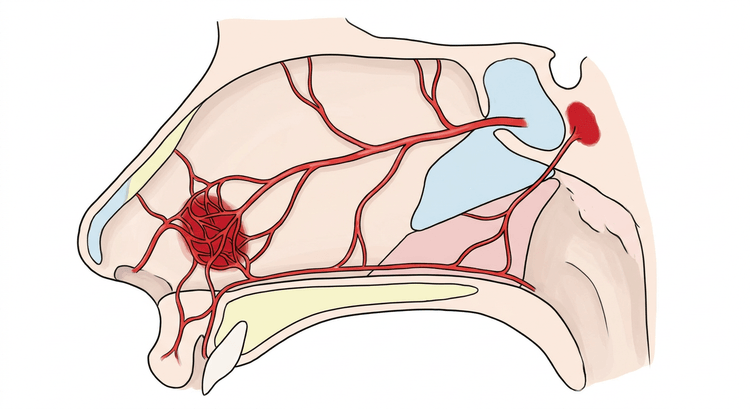
Indications
- Ongoing epistaxis that has not stopped spontaneously.
- Recurrent bleeding from a visible vessel on the septum (cautery).
- Continued bleeding despite compression and cautery (packing).
Contraindications
Cautery:
| Type | Contraindication |
|---|---|
| Absolute | The source of bleeding cannot be identified |
| Relative | A pacemaker or ICD when monopolar electrocautery is used |
| Relative | A cochlear implant |
| Relative | The contralateral side of the septum already cauterised — bilateral cautery carries a risk of perforation |
Anterior packing:
- Suspected base-of-skull fracture or a significant midfacial or nasal fracture (absolute).
- An unsecured airway or haemodynamic instability — stabilise the patient first.
- Marked septal deviation towards the bleeding side (relative).
Preparation and equipment
Personal protective equipment (gloves, a visor, an apron), suction with a Frazier tip, a nasal speculum, a head lamp, bayonet forceps, a tongue depressor, a vomit bowl.
- Local anaesthesia and vasoconstriction: lidocaine 4 % with oxymetazoline 0.5 % (or xylometazoline) on cotton pledgets.
- Cautery: silver nitrate sticks; electrocautery as a second choice.
- Packing: a compressed nasal tampon (polyvinyl acetate) with a drawstring, absorbable alternatives (oxidised cellulose, a gelatin–thrombin matrix), a balloon catheter, or petroleum jelly-impregnated ribbon gauze.
- Antibiotic ointment (for example mupirocin or bacitracin), saline, and an intravenous cannula for expanding the tampon.
- Topical tranexamic acid on a pledget or as a solution has a good effect in anterior bleeding.
Raise the chair so that the patient's nose is at your eye level. The patient sits upright and tilts the head forwards, not backwards.
Procedure
flowchart TD
  A[Ongoing nosebleed] --> B[Blow out the clot, decongestant spray, head forwards]
  B --> C[Compress the soft tip of the nose continuously for at least 10 minutes]
  C --> D{Has the bleeding stopped?}
  D -- Yes --> E[Instruct the patient; avoid aspirin and NSAIDs for 4 days]
  D -- No --> F[Anaesthetise and vasoconstrict, suction clear, look for the bleeding point with a speculum]
  F --> G{A visible bleeding point on the anterior septum?}
  G -- Yes --> H[Cauterise with silver nitrate, at most two attempts, never bilaterally on the same day]
  H --> I{Has the bleeding stopped?}
  I -- Yes --> E
  I -- No --> J[Anterior packing with a nasal tampon or petroleum jelly gauze]
  G -- No --> J
  J --> K{Is blood still running down into the pharynx?}
  K -- No --> L[Observe, antibiotic prophylaxis, remove the packing after 3-5 days]
  K -- Yes --> M[Suspect a posterior bleed: balloon tamponade, contact ENT, admit]
Step 1 — compression
Have the patient blow out the clot. The pinch is applied to the lower third of the nose, the soft part, and held continuously for at least 10 minutes without letting go to look. Compression can be preceded by a dose of decongestant spray. This alone stops the majority of all anterior bleeds.
Step 2 — cautery
- Suction clear and identify the bleeding point with a nasal speculum and a head lamp. Without a visible source, no cautery.
- Insert 2–3 pledgets with lidocaine and a vasoconstrictor vertically into the nose. Wait 10–15 minutes.
- Apply the silver nitrate stick to the vessel with light pressure, rolling it, for 4–5 seconds until a grey eschar forms. Start peripheral to the bleeding point and work inwards towards the centre.
- Wipe away excess silver nitrate so that the adjacent mucosa is not burned.
- Inspect again after 10–15 minutes. If the bleeding persists after two attempts — move on to packing.
- Apply antibiotic ointment to the cauterised area.
Step 3 — anterior packing
A compressed nasal tampon:
- Coat the tampon with antibiotic ointment and trim it to the length of the nasal cavity.
- Introduce it perpendicular to the face and then parallel to the floor of the nose in one smooth movement — never obliquely upwards towards the eye.
- Expand it with 5–10 mL of saline through an intravenous cannula.
- Tape the drawstring to a gauze pad against the cheek so that the packing cannot slip backwards.
- Place a second tampon if necessary so that the nasal cavity is completely filled.
- Observe for 10 minutes and check the pharynx — blood running down into the pharynx means that the bleeding is not controlled.
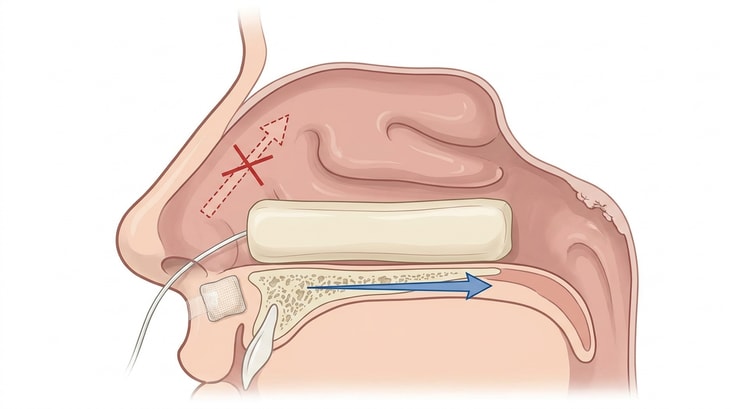
Petroleum jelly gauze often gives better pressure but requires more experience and hurts more: consider analgesia (fentanyl 0.5–1 µg/kg IV). Grasp the ribbon about 10 cm from the end with bayonet forceps, introduce it parallel to the floor of the nose, and lay it in layers, concertina-fashion, with each layer slightly in front of the previous one. Pack from below upwards. A complete anterior pack uses around 180 cm of gauze — if much less is used, the packing is probably bunching up anteriorly without reaching the bleeding point.
Children
In children the bleeding is almost always anterior and comes from Kiesselbach's plexus, usually after nose-picking, a dry mucosa or an infection. Correct compression is sufficient in the great majority of cases. Cautery can be performed in a cooperative child after good local anaesthesia, but never on both sides of the septum at the same session — the septum is thin and the risk of perforation greater than in adults. Anterior packing is poorly tolerated and should where possible be left to ENT.
Two findings should direct the thinking away from ordinary epistaxis: unilateral bleeding with foul-smelling, purulent discharge suggests a foreign body in the nose, and bleeding in a child under two, bleeding without a local explanation, or repeated heavy bleeds warrant investigation for a bleeding disorder.
When to suspect a posterior bleed
Blood that continues to run down into the pharynx despite correct anterior packing, heavy bleeding from both nostrils, or bleeding in an older patient with hypertension and anticoagulant treatment. A posterior bleed requires balloon tamponade and admission — these patients must not be sent home.
Complications
| Complication | Comment |
|---|---|
| Septal perforation | Above all after bilateral cautery or too deep a burn |
| Nasal synechiae | After extensive mucosal injury |
| Pressure necrosis | From packing that is too tight or a balloon that is overinflated |
| Backward migration of the packing | This can obstruct the airway — always secure the drawstring |
| Aspiration of packing material or blood | Sit the patient upright, suction clear |
| Sinusitis and, rarely, toxic shock syndrome | The rationale for antibiotic prophylaxis with non-absorbable packing |
| Rebleeding on removal | Common; have the equipment to hand |
Aftercare and follow-up
- Avoid aspirin and NSAIDs for 4 days after treated epistaxis.
- After cautery: petroleum jelly or an emollient ointment to the area 2–3 times daily for 3–5 days.
- Non-absorbable packing stays in place for 3–5 days, is moistened with saline three times daily, and is removed at a follow-up visit. Give antibiotic prophylaxis meanwhile.
- Absorbable packing dissolves with moisture; give saline spray three times daily.
- Instruct the patient: if the bleeding recurs — blow out the clot, use a decongestant spray, pinch the soft part for 20 minutes. Seek help if the bleeding continues or is heavy.
- Investigate the underlying cause in repeated bleeds: hypertension, anticoagulants and antiplatelet drugs, liver failure, hereditary haemorrhagic telangiectasia, and — with unilateral bleeding in an adult — a tumour of the nose or the sinuses.
Common pitfalls
- Compression on the nasal bone instead of the soft tip of the nose. Ask how the patient actually pinched.
- Too short a period of compression. Ten minutes without interruption, timed by the clock.
- The head tilted backwards — this puts blood in the pharynx and causes vomiting.
- Cautery without a visible source burns healthy mucosa without stopping the bleeding.
- Bilateral septal cautery at the same session — avoid it; the risk of perforation is real.
- Packing directed upwards towards the bridge of the nose instead of backwards along the floor — it hurts and ends up in the wrong place.
- Sending home a patient with blood in the pharynx. That is a posterior bleed until proven otherwise.
- Forgetting the anticoagulant history, and forgetting to check the haemoglobin in heavy or protracted bleeding.