Children around the age of three account for the majority of cases, and the great majority of objects can be removed in general practice or in the emergency department with simple equipment. Two principles determine the outcome: the first attempt is the best attempt, and a button battery is an emergency — it can cause perforation in seven hours.
Indications
Every foreign body in the ear canal or the nasal cavity must be removed. The urgency varies:
| Object | Urgency |
|---|---|
| Button battery | Immediately — leakage of fluid causes a chemical burn |
| Two or more magnets (including in different nostrils) | Immediately — pressure necrosis across the septum |
| A live insect | As soon as possible — kill it first; the patient is in great distress |
| Organic material (peas, beans) | The same day — it swells when moist |
| Sharp objects | The same day |
| Plastic bead, stone, toy | Within a day or so |
Unilateral, foul-smelling nasal discharge in a small child is a foreign body until proven otherwise.
Contraindications
Absolute: that you cannot see the object, or cannot reach it with the instruments available. Do not then try "by feel" — refer to ENT.
Relative — a low threshold for referral:
- Marked swelling or inflammation around the object.
- A small, smooth or transparent object lying posteriorly or superiorly.
- Attempts already made and failed elsewhere.
- A child who cannot be kept still without sedation.
- Suspected tympanic membrane perforation.
Irrigation is contraindicated in: suspected perforated tympanic membrane, organic material that swells, batteries and magnets.
Preparation and equipment
- A chair with a head rest, preferably an ENT chair; raise the chair to your eye level.
- A head lamp or another directable light source, an operating otoscope, a magnifying loupe.
- A nasal speculum and otoscope specula in several sizes.
- Alligator forceps, bayonet forceps, an angled hook, a cerumen loop.
- Suction with Frazier tips of various sizes.
- A balloon catheter (a 5–6 Fr Fogarty or a Katz extractor).
- A local anaesthetic with a vasoconstrictor for the nose: lidocaine 4 % with oxymetazoline 0.5 % on pledgets.
- Mineral oil or lidocaine to kill an insect in the ear canal.
- A 30–60 mL syringe with a soft catheter and body-temperature water for irrigation.
Small children need help to keep still. Sedation is usually better than physical restraint — ketamine provides both immobilisation and less psychological trauma than being held down by three adults.
Procedure
flowchart TD
  A[Suspected foreign body in the ear or nose] --> B{Button battery, several magnets or a sharp penetrating object?}
  B -- Yes --> C[Emergency: no irrigation, no delay, contact ENT immediately]
  B -- No --> D{Can you see the object and reach it with your instruments?}
  D -- No --> E[Refer to ENT, make no attempts by feel]
  D -- Yes --> F{Ear or nose?}
  F -- Nose --> G[Treat a swollen mucosa with a vasoconstrictor and a local anaesthetic, try positive pressure in small children]
  G --> H[Hook or loop behind a hard object, forceps on anything graspable, suction on a smooth object, balloon catheter for a posterior object]
  F -- Ear --> I[Kill an insect first, work under direct vision]
  I --> J[Hook or loop behind a hard object, forceps on anything graspable, suction on a smooth object, irrigation only with an intact tympanic membrane and inorganic material]
  H --> K{Object out within the limit you set in advance?}
  J --> K
  K -- Yes --> L[Inspect again, examine both ears, both nostrils and the mouth]
  K -- No --> E
Batteries and magnets
A button battery in the nose or the ear canal is an emergency, not a finding that can wait until the next day. Moisture completes a circuit across the mucosa, hydroxide ions are generated at the negative pole of the battery and produce a liquefactive necrosis that can reach the septal cartilage within a few hours; septal perforation has been described after as little as seven hours. Never irrigate and never instil fluid onto a battery — the moisture drives the reaction. The battery must come out immediately, with a hook, forceps or suction, and if that is not possible on the spot, ENT must be contacted urgently rather than a routine referral being made.
Two or more magnets constitute the same kind of urgency by a different mechanism. They attract one another through the tissue — even when they lie in separate nostrils, or one in the nose and one in the ear — and compress the mucosa and cartilage between them until pressure necrosis and perforation occur. If you find one magnet, actively look for another, in the other nostril, in the ears and in the mouth.
Nose
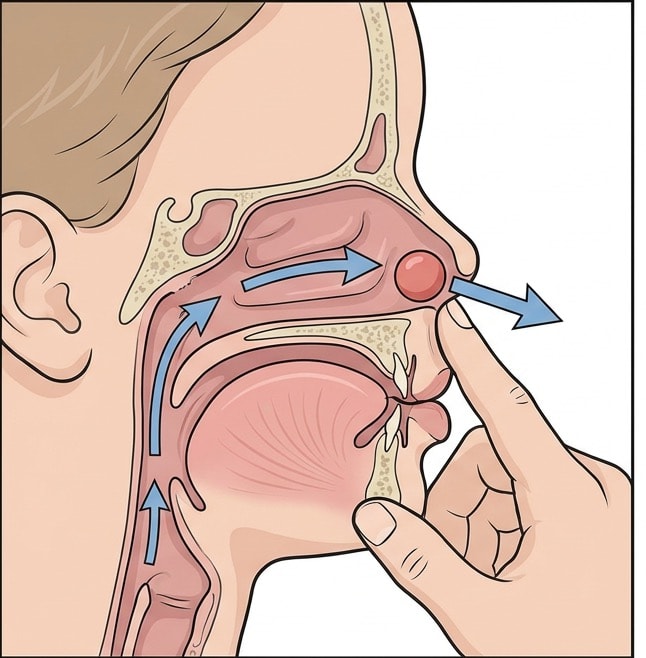
- Ask the patient to blow the nose gently. Clear mucus with suction without pushing the object backwards.
- Apply the anaesthetic and vasoconstrictor and wait 3–5 minutes. Repeat if swelling persists.
- Introduce the nasal speculum with the handle parallel to the floor and the index finger supported against the patient's nose and cheek. Open the speculum upwards–downwards, never sideways without support.
- Choose the technique according to the properties of the object:
- Soft or graspable — alligator forceps or bayonet forceps.
- Hard and anterior — pass an angled hook or a loop behind the object and draw it outwards.
- Smooth and round — a suction catheter against the surface, activate the suction, withdraw slowly.
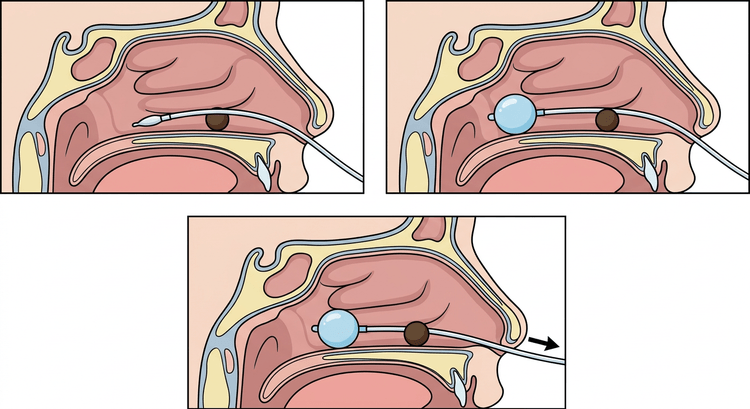
- Posterior or hard to reach — a balloon catheter: pass the deflated balloon beyond the object, inflate it with 2 mL (small child), 3 mL (older child) or 5 mL (adult), pull slowly until resistance is felt and then bring the object out.
Ear
- Inspect with an otoscope using the largest speculum that will fit. Assess the position of the object in relation to the isthmus and the tympanic membrane.
- An insect is killed first with mineral oil or lidocaine — a live insect that is moving makes examination impossible and can damage the tympanic membrane.
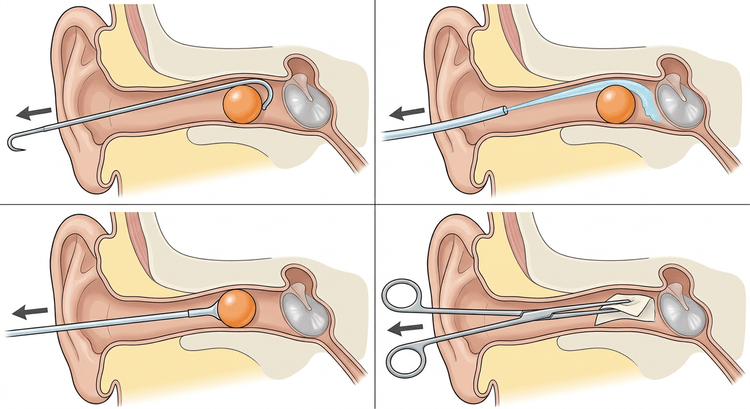
- Choose the technique:
- Small, loose material (sand, grit) — irrigation with body-temperature water directed past the object, provided the tympanic membrane is intact.
- Soft, round and smooth — a suction catheter.
- Graspable — alligator forceps.
- Hard and round — an angled hook or a loop passed beyond the object to draw it outwards. Forceps applied to a smooth bead only push it deeper.
- Work under direct vision throughout and never insert an instrument further than you can see.
Set a limit in advance — for example two attempts or ten minutes. The ear canal swells rapidly, and every failed attempt makes the next one harder.
Complications
- Mucosal injury with bleeding in the nose or ear canal.
- Tympanic membrane perforation, laceration of the ear canal, oedema with secondary impaction.
- Aspiration of the object, particularly in a sedated or cognitively impaired patient — keep the patient sitting upright.
- Infection; otitis externa after organic material has been left behind.
- Septal perforation and pressure necrosis from a battery or magnets.
Aftercare and follow-up
Always examine both nostrils, both ear canals and the mouth — a child with one foreign body often has more. Inspect again after removal: remnants, and a second body behind the first, are common.
Antibiotics are usually not needed. For mucosal injury in the nose, give saline spray and, if needed, a topical antibiotic ointment. For otitis externa after removal, give ear drops (avoid neomycin).
A battery or magnets must always be followed up by an ENT surgeon even if the removal was successful, to assess tissue damage and late complications such as septal perforation and synechiae.
Common pitfalls
- Grasping at a smooth, round bead with forceps — it slips deeper in with every attempt.
- Irrigating organic material — the pea swells and becomes wedged.
- An unlimited number of attempts. Set the limit before you begin.
- An unsupported nasal speculum. Never open the speculum sideways without support against the face.
- Missing the second magnet. Two magnets, one in each nostril, compress the septum and cause necrosis — look for it actively.
- Ignoring bleeding. Stop and consult ENT if bleeding obscures the view.
- Forgetting to examine the other cavities after a successful removal.