Injection technique is treated as self-evident and is therefore often done wrongly. The two commonest errors are that an intramuscular injection in fact ends up subcutaneously in a patient with a high BMI, and that the deltoid injection is placed too high — which causes the shoulder injury known as SIRVA. Both are avoided with the right landmark and the right needle length.
Indications
| Route | Typical drugs | Absorption |
|---|---|---|
| Intramuscular (IM) | Vaccines, depot antipsychotics, hydroxocobalamin, adrenaline in anaphylaxis, ceftriaxone, ferric carboxymaltose | Rapid, 10–20 min |
| Subcutaneous (SC) | Insulin, low-molecular-weight heparin, GLP-1 analogues, methotrexate, biological agents, adrenaline (second choice) | Slower, 20–30 min |
| Intradermal (ID) | Tuberculin (PPD), skin prick testing, a local anaesthetic weal, BCG | Slow, local effect |
Contraindications
Absolute:
- Infection, a wound, scar tissue, a tattoo or skin disease at the injection site.
- Known hypersensitivity to the preparation.
- Intramuscular injection in marked coagulopathy or thrombocytopenia (< 50 ×10⁹/L) — choose the subcutaneous route if possible, otherwise give IM with a fine needle and 5 minutes of compression. Anticoagulant treatment is not in itself a bar to vaccination.
Relative:
- Lymphoedema or previous axillary clearance on the same side.
- A paretic limb — poorer absorption.
- Injection into an arm with a dialysis fistula.
Preparation and equipment
- Hand disinfection; gloves where there is a risk of blood contact.
- An alcohol or chlorhexidine swab. Let the skin dry completely before inserting the needle — alcohol carried in with the needle stings.
- Needles of the correct length (see the table), a syringe of the correct size, a sharps bin.
- For vaccination: adrenaline 1 mg/mL, an antihistamine, oxygen, and the ability to lay the patient down.
| Injection | Needle | Angle | Maximum volume per site |
|---|---|---|---|
| Deltoid, adult | 23–25 G, 25 mm | 90° | 1–2 mL |
| Deltoid, BMI > 35 or a large arm | 23 G, 38 mm | 90° | 1–2 mL |
| Vastus lateralis, infant | 25 G, 16–25 mm | 90° | 0.5–1 mL |
| Ventrogluteal, adult | 21–23 G, 38 mm | 90° | 3–4 mL (5 mL for a depot preparation) |
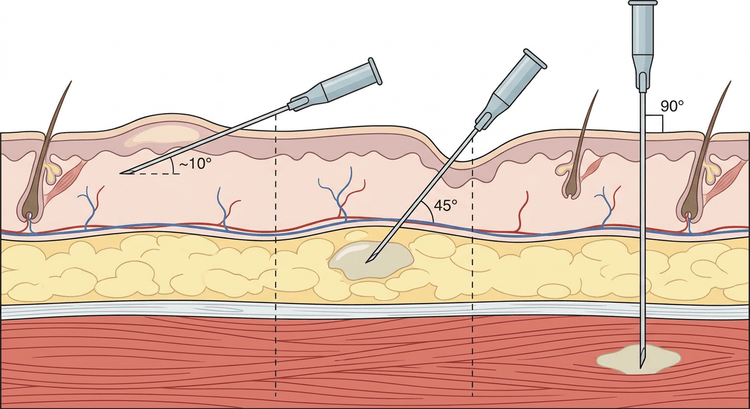
| Subcutaneous | 25–27 G, 8–16 mm | 45–90° | 1–2 mL |
| Intradermal | 26–27 G, 10 mm | 5–15° | 0.1 mL |
At a BMI above 35 or an arm circumference above 35 cm, a 38 mm needle is required to reach the deltoid muscle. With a 25 mm needle the dose ends up subcutaneously, which gives a poorer immune response and more local reaction.
Procedure
Intramuscular — deltoid
- Expose the whole shoulder; rolling up a sleeve creates a constriction that distorts the anatomy and tempts the operator to inject too high.
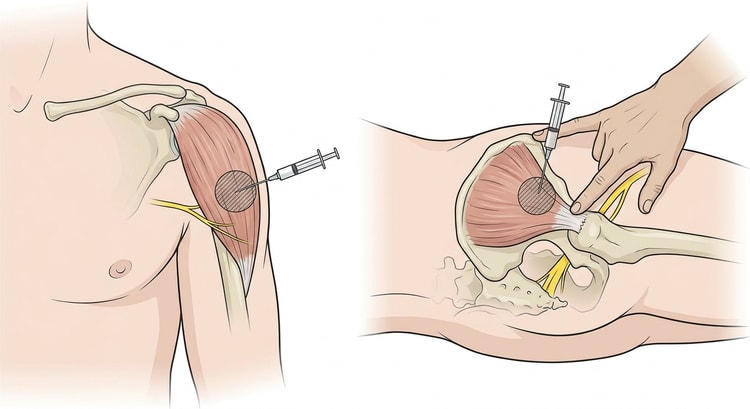
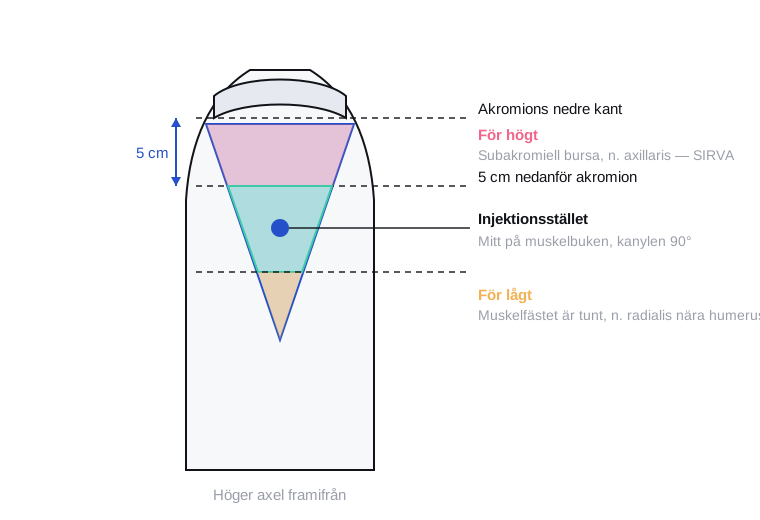
- Palpate the acromion. The injection site lies 2–3 fingerbreadths (about 5 cm) below the lower border of the acromion, in the middle of the muscle belly, within the inverted triangle formed between the acromion and the lower tip of the muscle insertion.
- Stretch the skin with the thumb and index finger, or compress the muscle in a slim patient.
- Insert the needle perpendicularly, quickly and firmly, to its full length.
- Aspiration is not needed for vaccination in the deltoid and vastus lateralis — there are no large vessels there, and aspiration merely hurts.
- Inject at an even rate, about 1 mL per 3–5 seconds.
- Withdraw the needle at the same angle and press with a dry swab. Do not massage.
Intramuscular — ventrogluteal
The first choice for larger volumes and depot preparations; safer than the dorsogluteal site because the sciatic nerve and the superior gluteal artery are avoided.
The patient lies on their side with the knee slightly flexed. Place the palm on the greater trochanter with the index finger towards the anterior superior iliac spine and the middle finger extended along the iliac crest. Inject into the triangle between the index and middle fingers.
The Z-track technique for depot preparations and irritant drugs: pull the skin and subcutaneous tissue 2–3 cm to one side, inject, wait 10 seconds, withdraw the needle and release the skin. The displaced track prevents the drug from leaking up into the subcutis.
Aspiration is not needed ventrogluteally either — there are no large vessels there. The only site at which aspiration is still recommended routinely is the dorsogluteal injection, which should be avoided altogether. Individual preparations specify aspiration in their summary of product characteristics; in that case follow the Swedish medicines compendium (FASS).
Subcutaneous
Lift a skin fold between the thumb and index finger. Insert the needle at 45° with a short needle, or at 90° with an 8 mm needle or in a patient with plentiful subcutaneous fat. Inject slowly and wait 10 seconds before withdrawing. Release the fold.
Rotate the injection sites with daily treatment — abdomen, thigh, the back of the upper arm, the buttock — and keep at least 2–3 cm from the previous site. Failure to rotate causes lipohypertrophy with unpredictable absorption, which is an underestimated cause of erratic blood glucose.
Do not inject within 5 cm of the umbilicus, into scars, into areas of lipohypertrophy, or into an area that is to be exercised hard within the next hour.
Intradermal
Stretch the skin on the volar forearm. Insert the needle almost parallel to the skin, bevel upwards, 2–3 mm. Inject 0.1 mL — a pale weal of 6–10 mm should appear. No weal means the injection went too deep; repeat at another site and record which one counts.
Complications
| Complication | Comment |
|---|---|
| Local pain, redness, swelling | The commonest; resolves within a few days |
| SIRVA (shoulder injury related to vaccine administration) | Bursitis or tendon injury from an injection placed too high; prolonged shoulder pain |
| Nerve injury | The axillary nerve from a deltoid injection placed too high, the sciatic nerve from a dorsogluteal injection |
| Sterile abscess and granuloma | From a depot preparation deposited subcutaneously |
| Lipohypertrophy and lipoatrophy | From failure to rotate the sites |
| Bleeding and haematoma | Above all with anticoagulant treatment |
| Infection | Uncommon with correct technique |
| Vasovagal syncope | Commonest in adolescents; have the patient sitting or lying |
| Anaphylaxis | Rare, but it requires preparedness on site |
Aftercare and follow-up
Observe for 15 minutes after vaccination, and 30 minutes after a previous allergic reaction. The patient must be sitting or lying; fainting after vaccination causes more injuries than the vaccine does.
Document the preparation, the batch number, the dose, the injection site and the side. When two vaccines are given in the same arm they must be at least 2.5 cm apart, otherwise use different arms.
Explain that local tenderness is expected and that a cold compress helps. Advise the patient to seek help if the pain increases, if there is fever or spreading redness, or if shoulder pain persists for more than a week after vaccination.
Common pitfalls
- Inserting the needle too high in the deltoid — the commonest technical error and the cause of SIRVA. Five centimetres below the acromion, not "up on the shoulder".
- Too short a needle in a patient with a high BMI: an intramuscular prescription, a subcutaneous reality.
- Routine aspiration during vaccination — unnecessary and painful.
- The dorsogluteal injection as first choice; the ventrogluteal site is safer.
- Failure to rotate with insulin and heparin.
- Injecting through clothing, or into skin that has not had time to dry after the alcohol swab.
- No observation period after vaccination.
- Massage after a depot injection — this accelerates release and can cause an unwanted peak effect.