An abscess is emptied, not treated away. Incision and drainage is the treatment; antibiotics are normally neither necessary nor sufficient in an uncomplicated cutaneous abscess in an otherwise healthy person. There are two ways the procedure fails: the incision is too small, so that the cavity closes again within a day, and the abscess sits somewhere that makes incision in the emergency department the wrong move — in the hand, in the medial triangle of the face or perianally.
Indications
- Fluctuant, tender, erythematous and indurated swelling in the skin or subcutis.
- Pilonidal abscess, hidradenitis abscess and paronychia with a collection of pus.
- Persistent painful induration after a few days of antibiotics — suggests that an abscess has formed.
Ultrasound settles the question when the clinical picture is unclear. Cellulitis without a pus cavity must not be incised — there, antibiotics are the treatment. Ultrasound shows the abscess as a hypoechoic or heterogeneous area whose contents move under pressure; cellulitis instead gives a diffuse oedematous picture without a demarcated fluid collection. Ultrasound also shows the depth of the cavity and its distance to vessels.
Contraindications and when to involve a surgeon
The following locations must not be handled routinely in primary care or in the emergency department without contacting the appropriate specialty:
| Location | Risk | Management |
|---|---|---|
| Medial triangle of the face (nasal root, alae nasi, upper lip) | Venous drainage towards the cavernous sinus | Surgeon or ENT; often antibiotics |
| Palm, fingers, tendon sheaths | Deep compartments and tendon sheaths, loss of function | Orthopaedic or hand surgeon, urgently |
| Perianal and perirectal | Often larger than it appears; risk of fistula | Surgeon, often operative management |
| Breast | Cosmesis, milk ducts, malignancy differential | Surgeon or mammography |
| Sole of the foot | Deep compartments | Orthopaedic surgeon |
| Close to large vessels, in the groin or on the neck | Bleeding, vascular injury, pseudoaneurysm | Surgeon, ultrasound first |
Other situations that argue for the operating theatre rather than the emergency room: a very large or deep abscess, a markedly unwell patient with fever and systemic upset, suspected necrotising soft tissue infection, a child who cannot tolerate the procedure while awake.
Suspected necrotising fasciitis — pain that is disproportionately severe, a rapid course, skin discolouration, systemic upset — is an acute surgical emergency, not an abscess.
flowchart TD
  A[Erythematous, tender and indurated swelling] --> B{Fluctuance or confident clinical diagnosis?}
  B -- Uncertain --> C[Ultrasound]
  C -- No pus cavity --> D[Cellulitis: antibiotics and clinical follow-up]
  C -- Pus cavity --> E{Dangerous location or deep abscess?}
  B -- Yes --> E
  E -- Yes --> F[Contact surgeon, hand surgeon or ENT]
  E -- No --> G[Incision and drainage under local anaesthesia]
  G --> H[Culture, irrigate and break down loculations]
  H --> I{Systemic upset, immunosuppression or extensive cellulitis?}
  I -- Yes --> J[Antibiotics in addition to drainage]
  I -- No --> K[No antibiotic]
Preparation and equipment
- No. 11 scalpel, curved haemostat, scissors, forceps, suction.
- Local anaesthesia: lidocaine 10 mg/mL with adrenaline (epinephrine). Syringe, 27 G and 21 G needles.
- Irrigation fluid (NaCl 9 mg/mL) and a 20 mL syringe.
- Culture swab, microbiology request form.
- Drainage material: rubber dam drain, a strip cut from a glove, petrolatum-impregnated packing strip or a vessel loop for loop drainage.
- Gauze, absorbent dressing.
Local anaesthesia works poorly in inflamed tissue — the acidic environment inactivates the anaesthetic. Place a field block in healthy skin around the abscess instead of injecting into it, and expect the procedure to hurt even so. Offer nitrous oxide, oral or intravenous analgesia, or procedural sedation in advance. Inadequate analgesia is the commonest reason for an incompletely performed drainage.
Procedure
- Locate the centre of the fluctuance, preferably with ultrasound if available. Mark the direction of the incision.
- Clean and drape. Place a field block around the abscess.
- Make the incision along the skin tension lines and make it long enough — as a rule of thumb, along the whole length of the abscess or at least half its diameter. Too small an incision is the commonest technical error.
- Cut straight into the cavity with a no. 11 scalpel until pus appears. Take a culture from the wall of the cavity before irrigating.
- Let the pus drain out. Empty it with gentle pressure around the cavity, not by pressing hard on the surrounding healthy tissue.
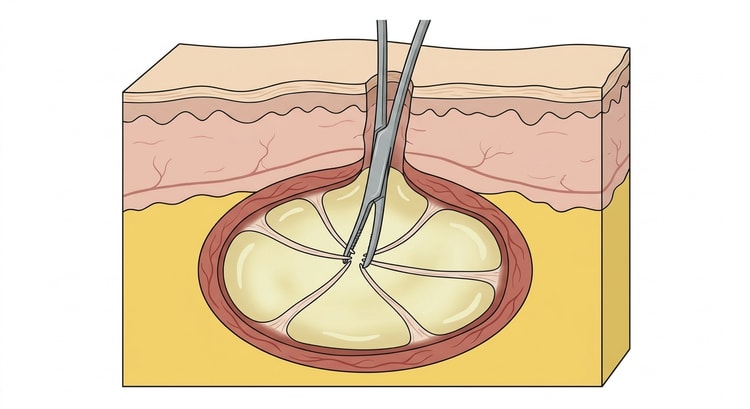
- Introduce a curved haemostat and open it in several directions to break up fibrous septa and turn all the compartments into a single cavity. Loculations left behind cause recurrence.
- Irrigate the cavity copiously with saline until the irrigation fluid runs clear.
- Keep the cavity open: packing strip, rubber dam drain or loop drainage. Pack loosely — tight packing causes pain and pressure necrosis without improving drainage.
- Absorbent dressing on top.
Packing or loop drainage
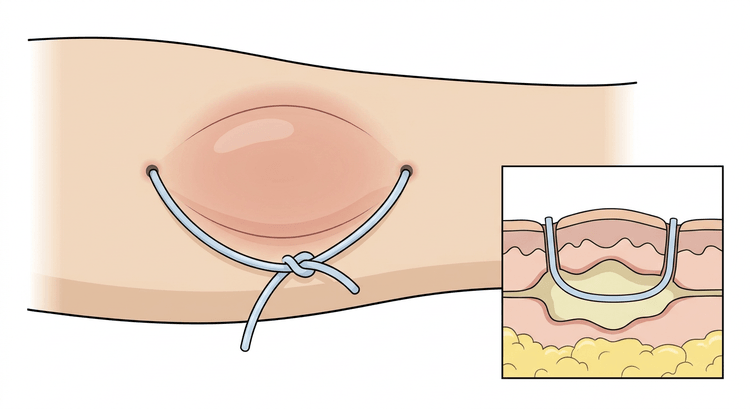
Classic packing with a strip keeps the cavity open but requires the patient to return for changes, which are often painful. Loop drainage is an alternative for abscesses on the trunk and limbs: two small stab incisions at either end of the cavity, through which a soft vessel loop or silicone tube is passed and tied loosely on the skin surface. The loop stays in place until secretion has stopped, usually 7–10 days, and the patient can look after it themselves. The method causes less pain and fewer return visits and is being used increasingly, but it is not established everywhere — check local practice.
Antibiotics
Antibiotics are not needed after adequate drainage of an uncomplicated abscess in a healthy patient. Consider adding them in:
- Marked surrounding cellulitis or lymphangitis.
- Fever, systemic upset or signs of systemic infection.
- Immunosuppression, poorly controlled diabetes, injecting drug use.
- Facial and hand abscesses, and locations where drainage has been incomplete.
- Prosthetic valve, previous endocarditis or joint prosthesis — here prophylaxis before the procedure may also be relevant.
A common first-line agent against staphylococci is flucloxacillin, and clindamycin in penicillin allergy. Perianal and perineal abscesses require anaerobic cover. Follow your local antibiotic policy and be guided by the culture result.
Complications
- Recurrence — almost always the result of too small an incision or loculations left behind.
- Incomplete drainage with persistent infection.
- Bleeding, particularly with an abscess close to vessels.
- Injury to nerve, tendon or vessel with a deep or poorly placed incision.
- Fistula formation, above all perianally.
- Spread to deeper compartments, sepsis.
- Scarring, particularly with an incision across the tension lines.
Aftercare and follow-up
The wound heals by secondary intention and must not be sutured. Showering is permitted from day one. Packing is changed after 1–2 days and thereafter until the cavity has begun to granulate from below; loop drainage stays in until secretion has stopped.
Review within 2–3 days to assess whether drainage has been sufficient. The patient should seek help earlier if there is fever, increasing erythema or increasing pain.
With recurrent abscesses: consider hidradenitis suppurativa, pilonidal sinus, diabetes, immunodeficiency or nasal staphylococcal carriage, and refer to dermatology or surgery for investigation rather than incising again.
Common pitfalls
- Too short an incision. The cavity closes and the abscess is back within a week.
- Loculations that are never broken down. The haemostat must go in in every direction.
- Antibiotics instead of the knife in a fluctuant abscess.
- Incising a cellulitis that has not matured — no pus is obtained, only pain. Ultrasound first if in doubt.
- Inadequate analgesia, so that the procedure is abandoned halfway through.
- Incision in the hand or in the medial triangle of the face without involving the appropriate specialty.
- No culture taken, which turns the antibiotic choice into guesswork if the patient deteriorates.