Emptying the stomach has gone from routine to exception. Activated charcoal — in Sweden usually called medicinal charcoal — is the first-line measure in decontamination, and gastric lavage is today a rare procedure reserved for very serious poisonings in which the patient reaches hospital early. The benefit of both methods falls steeply with the time since ingestion, and both can harm the patient through aspiration. Contact your national or regional poison control centre before you decide, not afterwards.
Indications
Medicinal charcoal is given after the ingestion of a potentially toxic dose of a substance that binds to charcoal, when it can be given early and the patient has an intact or a protected airway. The benefit is greatest within the first hour; within 30 minutes the absorption can be reduced by around half.
- Liquid preparations: in practice within about 1 hour.
- Tablets and solid preparations: up to about 2 hours.
- Modified-release preparations, anticholinergics, opioids and salicylate — where gastric emptying is delayed — may justify charcoal later, in some cases up to 6 hours or more. Discuss this with the poison control centre.
Gastric lavage is considered only after a life-threatening ingestion of a highly toxic substance, where the patient arrives within about 1 hour (a liquid preparation) or 2 hours (tablets). With very large quantities of an extremely toxic preparation, lavage can be discussed later. Lavage must never be performed routinely in poisoning — it rarely alters the course and adds a risk of aspiration.
Repeated doses of charcoal are given in serious poisoning with agents that undergo enterohepatic or enteroenteric recirculation, including carbamazepine, theophylline and quinine. Repeated dosing may also be appropriate after large ingestions of modified-release preparations.
Contraindications
| Measure | Contraindication |
|---|---|
| Medicinal charcoal | A reduced level of consciousness without a protected airway — a risk of aspiration |
| Medicinal charcoal | A corrosive substance (acid, alkali) — it makes endoscopic assessment more difficult and causes vomiting |
| Medicinal charcoal | Petroleum products — vomiting with chemical pneumonitis as a consequence |
| Medicinal charcoal | Bowel obstruction, ileus or suspected perforation |
| Gastric lavage | An unprotected or unsecured airway in a patient with a reduced level of consciousness |
| Gastric lavage | Corrosive injury or suspected oesophageal perforation |
| Gastric lavage | Petroleum products |
| Gastric lavage | Oesophageal varices, coagulopathy, recent oesophageal or gastric surgery |
| Gastric lavage | Seizures or an unstable patient — stabilise first |
The induction of vomiting has no place in the modern treatment of poisoning.
Charcoal also does not bind every poison. With the following substances charcoal is ineffective and management is instead governed by the antidote, supportive treatment or dialysis:
| Group | Examples |
|---|---|
| Metals and salts | Iron, lithium, potassium, lead, mercury |
| Alcohols and glycols | Ethanol, methanol, isopropanol, ethylene glycol |
| Corrosive substances | Strong acids and alkalis |
| Petroleum products | Lamp oil, petrol, turpentine, lighter fluid |
| Others | Cyanide, boric acid, fluoride |
Preparation and equipment
- Medicinal charcoal as a ready-made suspension or as a powder for suspension in water. A glass of water between doses of charcoal makes the drink more tolerable.
- A kidney dish, a beaker or a straw, tissues, and an apron for the patient — charcoal stains everything black.
- For administration by tube: a gastric tube and a 50–60 mL catheter syringe, and equipment for confirming the position.
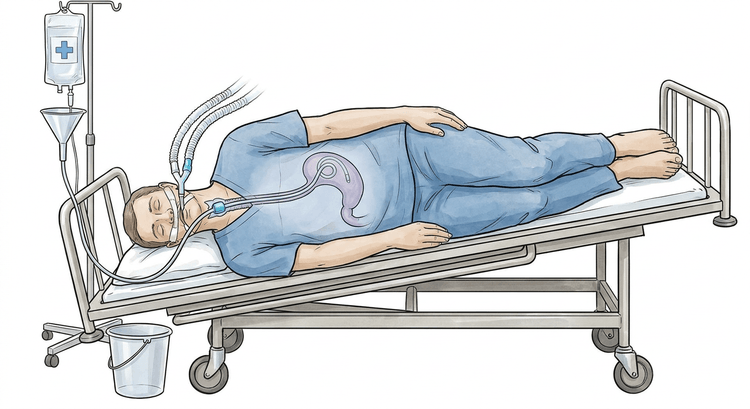
- For gastric lavage: a wide-bore orogastric tube (Ch 28–32 in an adult), a funnel or a lavage system, lukewarm fluid (tap water for adults, isotonic saline for children), a collecting vessel, a bite block, and powerful suction with wide-bore tubing.
- Working suction, oxygen and complete equipment for intubation and ventilation must be to hand before the lavage begins.
- The head of the trolley must be able to be lowered.
Take the poisoning investigations at the same time according to local practice: a blood gas with lactate, electrolytes, creatinine, liver function tests, coagulation, paracetamol, ethanol and salicylate, and an ECG.
Procedure
Medicinal charcoal
- Assess the airway first. Charcoal is given orally to an awake, cooperative patient with intact swallowing reflexes. With a reduced level of consciousness, charcoal is given only after intubation, through a tube.
- Adult dose: 50 g as a single dose (a range of 25–100 g appears in different sources depending on the amount ingested).
- Children: 1 g/kg body weight, in practice at least 10 g and preferably 25 g where the child will take it. For children aged 1–12 years, 25–50 g is often specified.
- Give the charcoal as soon as possible. Mix the powder in water to a thin slurry if powder is used and let the patient drink through a straw — it goes down more easily and smells less.
- Repeated doses where indicated: adults 25 g every four hours during the first 24 hours (that is, six doses), children 5–10 g every four hours. Check that bowel sounds are present before every further dose.
- With concurrent treatment with an oral antidote or another vital oral drug: remember that the charcoal binds these as well. Discuss the order with the poison control centre.
Gastric lavage
- Secure the airway first. A patient with a reduced level of consciousness must be intubated with a cuffed tube before the lavage. This is the single most important safety measure in the procedure.
- Place the patient in the left lateral position with the head end lowered by about 10–20 degrees. This position keeps the gastric contents in the fundus and reduces passage on into the duodenum and the risk of aspiration.
- Pass a wide-bore tube through the mouth and confirm its position before the lavage begins.
- Aspirate the gastric contents first — save a sample for possible toxicological analysis.
- Lavage with aliquots of about 200–250 mL of lukewarm fluid in an adult. In children, isotonic saline is used in aliquots of 10 mL/kg to avoid water intoxication and hypothermia.
- Check that the volume returned matches the volume instilled. Retained fluid distends the stomach and increases both the risk of aspiration and the risk of poison being pushed on into the small bowel.
- Continue until the returned fluid is clear, usually 5–10 washes.
- Give medicinal charcoal through the same tube before it is withdrawn, if charcoal is indicated.
- Clean the mouth and pharynx and suction them clear. Withdraw the tube with suction applied, or with the tube clamped, so that the contents do not run down into the pharynx.
With certain modified-release preparations and large tablet conglomerates, endoscopic removal may be an alternative to lavage — discuss this with the Poisons Information Centre and the endoscopist.
flowchart TD
  A[Acute poisoning with a potentially toxic dose] --> B{A corrosive substance or a petroleum product?}
  B -- Yes --> C[No decontamination. Contact the poison control centre]
  B -- No --> D{Does the substance bind to charcoal?}
  D -- No --> E[No decontamination. Antidote, supportive care or dialysis]
  D -- Yes --> F{Is the time since ingestion within the window? Liquid about 1 h, tablets about 2 h, modified-release longer}
  F -- No --> G[Charcoal is unlikely to help. Discuss with the poison control centre]
  F -- Yes --> H{Awake with intact swallowing reflexes?}
  H -- Yes --> I[Medicinal charcoal orally. Adult 50 g, child 1 g per kg]
  H -- No --> J[Intubate with a cuffed tube, then give charcoal through a tube]
  I --> K{A life-threatening ingestion of a highly toxic substance with early arrival?}
  J --> K
  K -- No --> L[Observation, repeated doses of charcoal for carbamazepine, theophylline or quinine]
  K -- Yes --> M[Consider gastric lavage with a secured airway in the left lateral position]
  M --> N[Give charcoal through the tube once the lavage is finished]
Complications
- Aspiration of charcoal or lavage fluid with chemical pneumonitis or ARDS — the most serious and the commonest complication, and the reason both methods are used restrictively.
- Vomiting during and after administration.
- Malposition of the tube in the airway with instillation of lavage fluid into the lung.
- Oesophageal or gastric perforation from trauma by a wide-bore tube, particularly with corrosive injury.
- Laryngospasm, bradycardia and hypoxia during passage of the tube.
- Water intoxication, hyponatraemia and hypothermia in children after lavage with hypotonic or unwarmed fluid.
- Constipation and, rarely, ileus or a bezoar after repeated doses of charcoal — particularly with concurrent anticholinergic or opioid effects on bowel motility.
- The charcoal makes later gastroscopy more difficult.
Aftercare and follow-up
- Continued monitoring of the level of consciousness, breathing, saturation, circulation and the ECG. That decontamination has been performed says nothing about how much poison has been absorbed — the patient must be monitored according to the toxicity of the substance and the time since ingestion.
- Auscultate the lungs and be alert for coughing, a falling saturation and fever in the hours after the procedure.
- Check bowel sounds and stool with repeated doses of charcoal, and stop at any sign of ileus.
- Check the electrolytes and temperature after lavage, particularly in children.
- Document the substance and quantity ingested, the time of ingestion, the time of the intervention, the dose of charcoal given, the lavage volume and the volume returned, and what the poison control centre recommended.
- All deliberate poisonings must be assessed psychiatrically before the patient is discharged, and the suicide risk assessment must be documented.
Common pitfalls
- Performing lavage instead of giving charcoal. Charcoal is the first-line measure; lavage is the exception.
- Giving charcoal to a drowsy patient without a protected airway. Wait with the charcoal until the airway is secured.
- Giving charcoal after a corrosive substance or a petroleum product — it does harm without doing good.
- Giving charcoal in metal, lithium or alcohol poisoning, where it binds nothing.
- Spending time on decontamination instead of on ABCDE, the antidote and supportive treatment. A patent airway and a corrected hypotension save more patients than a gastric lavage.
- Counting the time from arrival instead of from the ingestion.
- Forgetting the paracetamol level — asymptomatic paracetamol poisoning is easily missed and has an effective antidote.
- Not checking the returned volume during lavage.
- Not telephoning the poison control centre. The kinetics of the substance, not a general rule, determine what should be done.