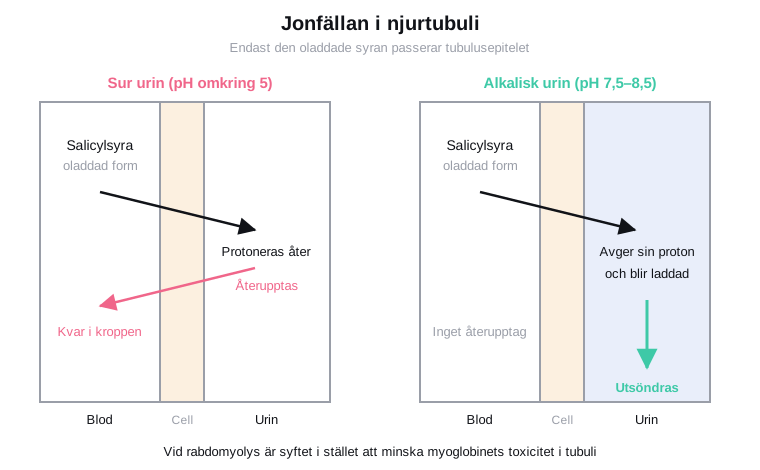
Alkalinising the urine increases the excretion of weak acids by keeping them in a charged form in the tubular fluid, where they cannot be reabsorbed. The treatment looks simple — bicarbonate and a look at the urine dipstick — but it fails routinely for one single reason: without normal potassium the urine cannot be alkalinised. The kidney then chooses to excrete hydrogen ions instead of potassium, and the urine stays acidic however much bicarbonate is given. Potassium replacement is not the management of a side effect; it is part of the treatment itself.
Indications
- Salicylate poisoning with symptoms or a rising serum concentration. Alkalinisation increases renal elimination several-fold and at the same time reduces the passage of salicylate into the central nervous system. Contact your national or regional poison control centre for advice on the treatment threshold and on whether haemodialysis should be considered.
- Rhabdomyolysis with marked elevation of CK and threatened kidney injury, as an adjunct to the decisive measure: early and generous fluid administration. The benefit of alkalinisation over fluids alone is disputed and practice differs between units.
- Poisoning with other weak acids where the poison control centre recommends it, for example certain phenoxy acid herbicides (2,4-D, MCPA) and methotrexate overdose.
- Tumour lysis syndrome appears as an indication in older protocols but is no longer routinely recommended — alkaline urine increases the precipitation of calcium phosphate.
Contraindications
- Hypokalaemia — must be corrected first or in parallel; otherwise the treatment is ineffective.
- Hypocalcaemia, symptomatic. Alkalosis increases the binding of calcium to albumin and lowers ionised calcium further; risk of tetany and seizures.
- Anuria or established renal failure. Without urine production there is no urine to alkalinise, and the sodium and volume load becomes pure harm. Dialysis is then the way forward.
- Heart failure, pulmonary oedema and other conditions with a high risk of fluid overload — a relative contraindication requiring invasive monitoring and slower administration.
- Significant metabolic alkalosis or an arterial pH above 7.55 already before starting.
- Severe hypernatraemia.
Preparation and equipment
- Two peripheral venous cannulas, or a central venous catheter for longer treatment.
- Sodium bicarbonate 50 mg/mL (corresponding to 0.6 mmol sodium bicarbonate per mL) for bolus and infusion, and glucose 50 mg/mL as carrier solution according to local protocol.
- Potassium chloride for infusion.
- Urine dipstick with a pH scale, or urine pH measurement on a blood gas analyser.
- Blood gas equipment for arterial sampling.
- Urinary catheter with hourly urine output measurement — the treatment cannot be guided without reliable measurement of urine output.
- Baseline tests: blood gas with electrolytes, sodium, potassium, ionised calcium, creatinine, CK in rhabdomyolysis, and salicylate concentration in poisoning.
Procedure
- Contact your national or regional poison control centre in poisoning before treatment is started. They give current advice on the treatment threshold, sampling intervals and when dialysis should be considered.
- Take baseline tests: arterial blood gas, sodium, potassium, ionised calcium, creatinine and the relevant toxicology concentration.
- Correct the hypokalaemia. Aim for a serum potassium in the upper normal range, around 4.0–4.5 mmol/L, and continue replacement throughout the treatment. This is the prerequisite for the urine pH to be able to rise.
- Insert a urinary catheter and start hourly urine output measurement.
- Give a bolus of sodium bicarbonate 1–2 mmol/kg intravenously in symptomatic salicylate poisoning. For an adult this corresponds to the order of 100–200 mL of the 50 mg/mL solution.
- Continue with a continuous infusion of sodium bicarbonate, titrated against the urine pH. A common starting point is an infusion rate giving about 2–3 mL/kg/hour of a bicarbonate-containing solution, with added potassium. The exact mixture, concentration and rate follow local protocol and the recommendation from the poison control centre.
- Aim for a urine pH of 7.5–8.5 and a urine output of around 1–2 mL/kg/hour.
- Measure the urine pH every hour initially. If it does not rise despite an ongoing bicarbonate infusion: check the potassium first — that is almost always the explanation.
- Check an arterial blood gas every 1–2 hours. Keep the arterial pH below 7.55. If the systemic pH rises above that limit, the infusion must be reduced or paused even if the urine pH has not yet reached target.
- Check ionised calcium at least every four hours and replace if there are symptoms or low values.
- Follow the fluid balance hour by hour. Auscultate the lungs, weigh the patient daily and be alert to a rising oxygen requirement.
- Stop when the toxicology concentration has fallen and the patient is free of symptoms, or when CK has turned downwards and urine output is good.
flowchart TD
  A[Indication for alkalinisation] --> B[Baseline tests: blood gas, potassium, ionised calcium, creatinine, toxicology sample]
  B --> C{Serum potassium below 4.0 mmol/L?}
  C -- Yes --> D[Replace potassium first and continuously]
  C -- No --> E[Urinary catheter and hourly urine output]
  D --> E
  E --> F[Bolus sodium bicarbonate 1-2 mmol per kg]
  F --> G[Continuous bicarbonate infusion with added potassium]
  G --> H[Measure urine pH every hour]
  H --> I{Urine pH 7.5 to 8.5?}
  I -- No, too low --> J{Arterial pH below 7.55?}
  J -- Yes --> K[Check potassium, increase the infusion]
  J -- No --> L[Do not increase. Systemic alkalosis limits the treatment]
  K --> H
  L --> M[Consider dialysis or another route of elimination]
  I -- Yes --> N[Continue, follow blood gas, potassium and calcium]
  N --> O{Toxicology concentration falling and patient free of symptoms?}
  O -- No --> N
  O -- Yes --> P[Taper and stop]
Figure 2. Management of urinary alkalinisation. Checking the potassium comes before the bicarbonate in the sequence and is repeated throughout the treatment. The arterial pH sets the ceiling: once it has reached 7.55 the urine pH cannot be driven higher with bicarbonate.
Why hypokalaemia makes alkalinisation impossible
flowchart LR
  A[Hypokalaemia] --> B[Potassium depletion in the cells of the distal tubule]
  B --> C[Hydrogen ions are excreted instead of potassium]
  C --> D[Paradoxically acidic urine despite bicarbonate infusion]
  D --> E[Bicarbonate leaks into the urine without raising the urine pH]
  E --> F[A higher bicarbonate dose gives systemic alkalosis but no effect]
  A --> G[Alkalosis drives potassium into the cells]
  G --> A
Figure 3. The self-reinforcing trap in hypokalaemia. Alkalinisation drives further potassium into the cells and worsens the hypokalaemia, while the hypokalaemia makes the kidney excrete hydrogen ions instead of potassium. Without generous and continuous potassium replacement the urine pH cannot be raised.
Complications
| Complication | Comment |
|---|---|
| Hypokalaemia | Expected and requires treatment. Causes arrhythmias and renders the alkalinisation ineffective |
| Hypocalcaemia | Alkalosis lowers ionised calcium. Paraesthesiae, tetany, seizures, prolonged QT |
| Fluid overload and pulmonary oedema | Particularly in heart failure, renal failure and old age. Follow hourly urine output and auscultation findings |
| Hypernatraemia | The sodium load is substantial at high infusion rates |
| Systemic metabolic alkalosis | Keep the arterial pH below 7.55; excessive alkalosis impairs oxygen delivery to the tissues |
| Precipitation of calcium phosphate | A reason not to alkalinise routinely in tumour lysis syndrome |
| Local irritation on extravasation | Bicarbonate solution is strongly alkaline. Check the cannula site regularly |
Aftercare and follow-up
- Taper the infusion rather than stopping abruptly, and follow the potassium for a further 24 hours — potassium redistributes back out of the cells as the alkalosis resolves.
- Check electrolytes, creatinine and blood gas after the treatment has ended.
- In rhabdomyolysis: continue fluid administration and follow CK, creatinine and urine output until CK has turned clearly downwards.
- In poisoning: continue to monitor the toxicology concentration as recommended by the poison control centre, and arrange medical and psychiatric assessment after a deliberate overdose.
- Document the indication, the amount of bicarbonate given, the urine pH achieved, the potassium requirement and any complications.
Common pitfalls
- Starting bicarbonate without replacing potassium first and continuously. The single most common reason why the treatment does not work.
- Guiding treatment by the systemic pH instead of the urine pH — or, conversely, driving the urine pH without checking the arterial pH. Both must be followed.
- Not inserting a urinary catheter. Without hourly urine output neither effect nor fluid balance can be assessed.
- Missing the hypocalcaemia. Ionised calcium falls as the pH rises, and the symptoms can be mistaken for toxic effects.
- Continuing to alkalinise in anuria. There dialysis is the answer, not more bicarbonate.
- Forgetting the poison control centre. Thresholds for treatment and for dialysis change and should be obtained from the centre, not from memory.
- Regarding alkalinisation as the main treatment in rhabdomyolysis. Fluid, given early and in sufficient amounts, is what protects the kidneys.