Oxygen is a drug and must be prescribed as one: with an indication, a route of administration and a target range for the saturation. What usually goes wrong is not that the patient gets too little oxygen but that the prescription has no target — the nasal cannula stays in place for days without anyone asking why, or the patient at risk of carbon dioxide retention is given 15 litres on a reservoir mask and drifts off into a respiratory acidosis. Treatment is guided by the saturation and the blood gas, not by the diagnosis alone.
Indications
- Hypoxaemia: a saturation below the target range, or a PaO2 below 8 kPa on an arterial blood gas.
- Acute critical illness during initial stabilisation — cardiac arrest, shock, sepsis, major trauma, unconsciousness — until the saturation can be measured reliably.
- Conditions in which oxygen is given irrespective of the saturation (see below).
Oxygen does not relieve breathlessness in a patient who is not hypoxaemic. Breathlessness without hypoxaemia is not an indication for oxygen — look for the cause instead.
Conditions in which the highest possible oxygen concentration is given irrespective of the saturation
- Carbon monoxide poisoning. The pulse oximeter does not distinguish carboxyhaemoglobin from oxyhaemoglobin and shows a falsely normal value. Give 100 % oxygen on a reservoir mask — this markedly shortens the half-life of carbon monoxide. Contact your national or regional poison control centre regarding hyperbaric treatment.
- Cluster headache. High-flow oxygen on a reservoir mask is the first-line treatment during an attack and aborts most attacks within 15–20 minutes.
- An undrained pneumothorax. A high oxygen concentration washes nitrogen out of the pleural air and speeds resorption.
Other conditions in which high-flow oxygen is given irrespective of the saturation according to international guidelines are decompression sickness and sickle cell crisis.
Contraindications
There are no absolute contraindications in hypoxaemia. Take particular care in:
- A risk of hypercapnic respiratory failure — COPD, severe obesity with hypoventilation, neuromuscular disease, marked chest wall deformity, severe bronchiectasis and cystic fibrosis. Here a lower target range and controlled delivery apply — not the withholding of oxygen.
- Previous bleomycin treatment — hyperoxia increases the risk of pulmonary toxicity. Keep the saturation in the lower part of the target range.
- Paraquat poisoning — oxygen worsens the lung injury. Discuss with your national or regional poison control centre.
- An open flame or smoking in the room: a fire hazard.
Preparation and equipment
- A pulse oximeter, and the ability to take an arterial blood gas.
- An oxygen source with a flow meter, and equipment for humidification at high flows and during prolonged treatment.
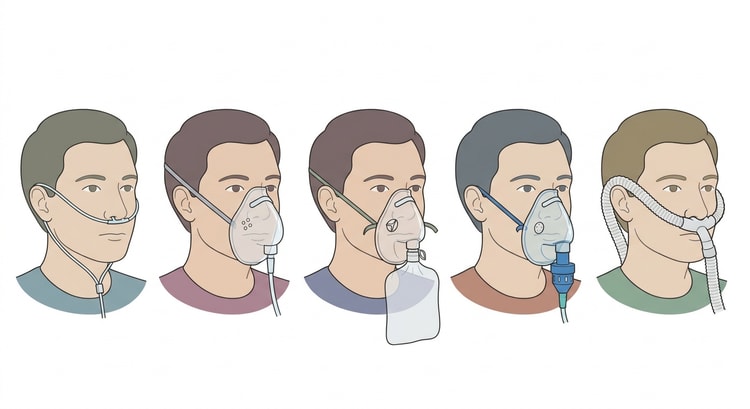
- A nasal cannula, a simple mask, a mask with a reservoir, a Venturi mask with a set of valves, and a high-flow nasal cannula where available.
- Bag-mask equipment for a patient who is not breathing adequately.
Choosing a system
| System | Flow | Approximate FiO2 | Comment |
|---|---|---|---|
| Nasal cannula | 1–6 L/min | 24–44 % | Comfortable; the patient can eat and talk. Flows above 6 L/min dry the mucosa without delivering more oxygen |
| Simple face mask | 5–10 L/min | 35–60 % | Never below 5 L/min — the patient then rebreathes carbon dioxide from the mask |
| Mask with a reservoir | 10–15 L/min | 60–90 % | For acute severe hypoxaemia. Fill the bag before applying the mask |
| Venturi mask | 2–15 L/min depending on the valve | 24, 28, 31, 35, 40 or 50 % | Gives a fixed, known FiO2 independently of the patient's breathing pattern. The first choice where there is a risk of hypercapnia |
| High-flow nasal cannula | 20–60 L/min | 21–100 %, adjustable | Humidified and warmed gas; it provides some positive airway pressure and washes out dead space. It requires special equipment and monitoring |
The nasal cannula, the simple mask and the reservoir mask deliver an FiO2 that varies with the patient's minute ventilation: a markedly hyperventilating patient entrains room air around the mask and receives a lower FiO2 than the table indicates. The Venturi mask is the only low-flow system that delivers a predictable oxygen concentration — which is why it is used when the carbon dioxide is the concern.
{
  "$schema": "https://vega.github.io/schema/vega-lite/v5.json",
  "description": "Approximate FiO2 as a function of oxygen flow for different systems",
  "width": "container",
  "height": 260,
  "data": {
    "values": [
      {"system": "Nasal cannula", "flode": 1, "fio2": 24},
      {"system": "Nasal cannula", "flode": 2, "fio2": 28},
      {"system": "Nasal cannula", "flode": 3, "fio2": 32},
      {"system": "Nasal cannula", "flode": 4, "fio2": 36},
      {"system": "Nasal cannula", "flode": 5, "fio2": 40},
      {"system": "Nasal cannula", "flode": 6, "fio2": 44},
      {"system": "Simple mask", "flode": 5, "fio2": 40},
      {"system": "Simple mask", "flode": 6, "fio2": 45},
      {"system": "Simple mask", "flode": 8, "fio2": 55},
      {"system": "Simple mask", "flode": 10, "fio2": 60},
      {"system": "Mask with reservoir", "flode": 10, "fio2": 60},
      {"system": "Mask with reservoir", "flode": 12, "fio2": 75},
      {"system": "Mask with reservoir", "flode": 15, "fio2": 90},
      {"system": "Venturi mask", "flode": 2, "fio2": 24},
      {"system": "Venturi mask", "flode": 4, "fio2": 28},
      {"system": "Venturi mask", "flode": 6, "fio2": 31},
      {"system": "Venturi mask", "flode": 8, "fio2": 35},
      {"system": "Venturi mask", "flode": 10, "fio2": 40},
      {"system": "Venturi mask", "flode": 15, "fio2": 50}
    ]
  },
  "mark": {"type": "line", "point": true},
  "encoding": {
    "x": {
      "field": "flode",
      "type": "quantitative",
      "title": "Oxygen flow (L/min)",
      "scale": {"domain": [0, 16]}
    },
    "y": {
      "field": "fio2",
      "type": "quantitative",
      "title": "Approximate FiO2 (%)",
      "scale": {"domain": [20, 100]}
    },
    "color": {"field": "system", "type": "nominal", "title": "System"}
  }
}
Figure 2. Approximate inspired oxygen concentration at different flows. The values for the nasal cannula, the simple mask and the reservoir mask are guide values at a normal minute ventilation and can differ considerably in a patient breathing rapidly and deeply. The Venturi mask points are instead the marked values of the valves at each recommended flow and apply independently of the breathing pattern. The high-flow nasal cannula is omitted, since its FiO2 is set directly and is independent of the flow.
Target saturation
| Patient group | Target range |
|---|---|
| Most acutely ill adults | 94–98 % |
| A risk of hypercapnic respiratory failure (COPD, obesity hypoventilation, neuromuscular disease, chest wall deformity, bronchiectasis, cystic fibrosis) | 88–92 %, until a blood gas indicates otherwise |
| Carbon monoxide poisoning, cluster headache, an undrained pneumothorax | The highest possible oxygen concentration irrespective of the saturation |
Where there is a known risk of carbon dioxide retention, 88–92 % applies from the prehospital phase and in the resuscitation room onwards. Take an arterial blood gas as soon as possible — if the PaCO2 rises and the pH falls, the answer is rarely less oxygen in itself but non-invasive ventilation.
In myocardial infarction, oxygen is given only for hypoxaemia. Routine oxygen for the normoxaemic infarct patient does not improve the outcome, and the Swedish DETO2X-AMI trial showed no difference in mortality. The same applies in stroke: oxygen for a patient who is not hypoxaemic is of no benefit.
Procedure
- Measure the saturation on a warm, well perfused limb. A cold periphery, nail varnish, movement and marked anaemia all give unreliable values — if in doubt, take an arterial blood gas.
- Decide the target range before the oxygen is connected: 94–98 % or 88–92 %.
- In acute critical illness with an uncertain saturation: start with a reservoir mask at 15 L/min and titrate down as soon as measurements are available.
- Choose the system according to how much oxygen is needed and how reliable the FiO2 must be. Where there is a risk of hypercapnia: start with a Venturi mask at 24 or 28 %, or a nasal cannula at 1–2 L/min.
- Check that the equipment is working as intended: the reservoir bag must be filled and must not collapse completely on inspiration, the mask must seal over the bridge of the nose, and the prongs of the cannula must sit in the nostrils.
- Document the prescription with the system, the flow and the target range on the drug chart.
- Check the saturation after 5 minutes, and take an arterial blood gas within 30–60 minutes where there is a risk of hypercapnia, where the picture is unclear, or when the flow has had to be increased.
- Titrate down actively. As soon as the saturation is above the target range the flow must be reduced — not maintained for safety's sake.
- Stop the oxygen when the patient stays within the target on room air, and check the saturation 5 minutes after it has been stopped.
Complications
- Carbon dioxide retention with respiratory acidosis in the patient sensitive to hypercapnia. It presents as increasing drowsiness, headache, a flapping tremor and finally unconsciousness — not as breathlessness.
- Hyperoxia. Vasoconstriction in the coronary and cerebral vessels, oxidative stress, and increased mortality in observational data in the critically ill.
- Absorption atelectasis at a high FiO2 over a prolonged period.
- Dry mucosa, epistaxis and pressure sores from the cannula, the mask edge and the tubing behind the ears.
- A delayed diagnosis: oxygen normalises the saturation but conceals the deterioration going on beneath it.
- A fire hazard with smoking or an open flame.
Aftercare and follow-up
- Review the oxygen prescription at least once a day — is it still needed, and is the patient within the target range?
- Change the cannula or mask according to local procedure and inspect the skin behind the ears, over the bridge of the nose and on the cheeks.
- Humidify at flows above 4 L/min by nasal cannula over a longer period, and always with a high-flow nasal cannula.
- Patients who have been hypoxaemic during an admission should have the saturation or a blood gas checked once they are stable before home oxygen is considered. Long-term oxygen therapy is prescribed by respiratory medicine after repeated blood gases in a stable phase — never on the basis of a single measurement during an exacerbation.
- Patients with COPD who have come close to hypercapnic failure should be given a written oxygen alert card with their target range to show in the ambulance and in the emergency department.
Common pitfalls
- Oxygen without a prescribed target range. Without a target there is nothing to titrate against.
- Withholding oxygen from a hypoxaemic COPD patient for fear of carbon dioxide retention. Hypoxia kills faster than hypercapnia — aim for 88–92 %, measure the blood gas, but give the oxygen.
- A simple mask at a low flow (below 5 L/min) — the patient rebreathes their own carbon dioxide from the mask.
- A reservoir mask with an unfilled bag, or with too low a flow so that the bag collapses with every breath.
- Routine oxygen in myocardial infarction without hypoxaemia. No benefit, possible harm.
- Trusting the pulse oximeter in carbon monoxide poisoning. It shows a normal value while the patient is severely hypoxic at tissue level.
- Forgetting to titrate down. The commonest iatrogenic hyperoxia arises after the patient has been stabilised.
- Interpreting a falling saturation despite an increased flow as an oxygen problem. It is usually a ventilation or shunt problem requiring a different intervention.