CPAP and NIV are two different treatments with different physiology, and the commonest source of error is confusing them. CPAP delivers a constant pressure that recruits alveoli and unloads the heart, whereas bilevel NIV delivers pressure support above the expiratory pressure and thereby increases ventilation and lowers the carbon dioxide. Pulmonary oedema calls for the former, a COPD exacerbation with carbon dioxide retention for the latter. The treatment is also time-limited by its very nature: a patient who has not responded within a couple of hours should be intubated, not given another hour.
Indications
CPAP:
- Acute cardiogenic pulmonary oedema with hypoxaemia and marked work of breathing — the strongest indication, with a rapid effect on dyspnoea and oxygenation.
- Atelectasis and postoperative hypoxaemia.
- Hypoxaemic failure where high-flow nasal oxygen is insufficient and the carbon dioxide is normal.
Bilevel NIV:
- Acute exacerbation of COPD with respiratory acidosis, that is, a pH below 7.35 and a PaCO₂ above 6.0 kPa despite optimal medical treatment with bronchodilators, steroids and controlled oxygen.
- Acute-on-chronic hypercapnic failure in obesity hypoventilation and neuromuscular disease.
- Hypercapnic failure in cardiogenic pulmonary oedema that does not improve with CPAP alone.
- As ceiling therapy where intubation has been judged not to be appropriate.
Contraindications
- Respiratory arrest, agonal breathing or cardiac arrest — intubate.
- Inability to protect the airway: a reduced level of consciousness not attributable to hypercapnia, marked swallowing difficulty, vomiting.
- Haemodynamic instability or a life-threatening arrhythmia.
- Undrained pneumothorax.
- Facial trauma, facial burns or recent facial surgery that make a seal impossible.
- Recent surgery on the oesophagus or upper gastrointestinal tract, ileus and ongoing upper gastrointestinal bleeding.
- Marked agitation or inability to cooperate.
- Copious secretions without an effective cough.
Choice of method and settings
| Condition | Method | Starting pressure | Escalation | Oxygen target |
|---|---|---|---|---|
| Cardiogenic pulmonary oedema | CPAP | 5–7.5 cmH₂O | Increase in steps of 2.5 to 10–12.5 cmH₂O according to tolerance and effect | SpO₂ 94–98% |
| COPD exacerbation with pH < 7.35 | Bilevel NIV | IPAP 12–15 and EPAP 4–5 cmH₂O | Increase the IPAP in steps of 2–3 cmH₂O every 5–10 min towards 20–25 cmH₂O according to tolerance and pCO₂ | SpO₂ 88–92% |
| Obesity hypoventilation | Bilevel NIV | IPAP 14–16 and EPAP 6–8 cmH₂O | Increase the EPAP against obstruction, the IPAP against hypercapnia | SpO₂ 88–92% |
| Hypoxaemic failure without hypercapnia | CPAP or high-flow nasal oxygen | 5–10 cmH₂O | According to oxygenation requirement | SpO₂ 92–96% |
The pressure support is the difference between IPAP and EPAP, and it is this that does the work of ventilation — raising IPAP and EPAP by the same amount does not increase ventilation at all. The backup rate is usually set at 12–16 breaths per minute. Regional protocols and the terminology used by different devices vary; follow the local setting instructions for the device available on the unit.
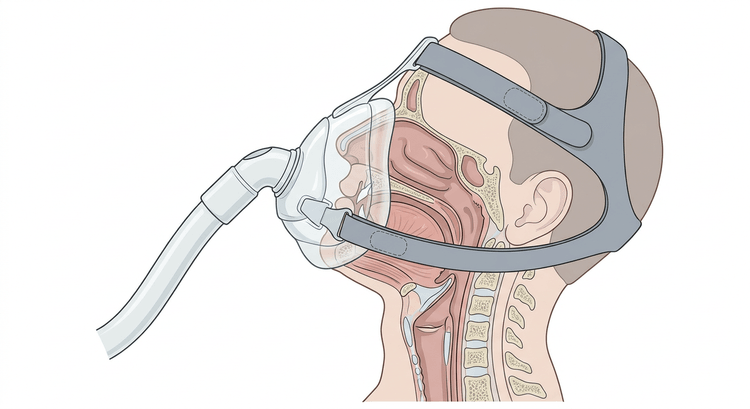
Preparation and equipment
- A device capable of both CPAP and bilevel ventilation, or alternatively flow-generated CPAP with a PEEP valve.
- Masks in several sizes. An oronasal mask is first choice in the acute setting; nasal masks and total face masks are alternatives in intolerance.
- A hydrocolloid dressing for the bridge of the nose applied before the mask goes on, not after the sore has developed.
- Humidification, suction and the facility to give nebulised drugs within the circuit.
- Monitoring: continuous pulse oximetry, ECG, blood pressure, respiratory rate.
- A blood gas before starting and after about 1 hour — without a blood gas the treatment cannot be guided.
- A decision on the level of care and on whether intubation is appropriate, documented before treatment begins.
Procedure
- Treat the underlying cause in parallel. Nitroglycerin and diuretics in pulmonary oedema, bronchodilators and steroids in COPD — NIV does not replace medical treatment.
- Sit the patient up, at 30–45° or higher.
- Take an arterial or capillary blood gas as a baseline and note the time.
- Select the correct mask size using a sizing gauge and prepare the bridge of the nose with a hydrocolloid dressing.
- Hold the mask loosely against the face with your hand for the first few minutes while the device runs at a low pressure and the patient becomes accustomed to it. Keep explaining what is happening throughout.
- Tighten the head straps only once the patient accepts the mask, and only enough to stop the leak — two fingers should fit under the straps.
- Escalate the pressure in small steps according to the table above, guided by respiratory rate, work of breathing, tidal volume and tolerance.
- Titrate the oxygen to the correct target. In COPD the target is SpO₂ 88–92%; a higher saturation can worsen carbon dioxide retention.
- Check for leaks and synchronisation, and that the patient is triggering the device. In dyssynchrony: adjust the trigger, rise time and inspiratory time before increasing the pressure.
- Repeat the blood gas after 1 hour, and then after about 4 hours or with any clinical deterioration.
- Reassess: respiratory rate, work of breathing, level of consciousness, pH and pCO₂. Improvement should be evident within 1–2 hours.
Where the response is good, treatment continues for as long as possible during the first 24 hours with short breaks for drinks, medication and mouth care, and is then tapered towards intermittent and overnight use.
When NIV should be abandoned in favour of intubation
flowchart TD
  A[NIV or CPAP started, blood gas taken] --> B{Contraindication or immediate threat: unconsciousness, vomiting, shock?}
  B -- Yes --> C[Intubate now]
  B -- No --> D[Optimise mask, pressure and synchronisation for 1 hour]
  D --> E{Blood gas after 1 hour: rising pH and falling pCO2?}
  E -- Yes --> F[Continue NIV, repeat blood gas after about 4 hours]
  E -- No, pH below 7.25 or rising pCO2 --> G[Intubate unless there is a treatment ceiling]
  F --> H{Persistent respiratory rate above 35 per minute, SpO2 below 88 per cent despite maximal oxygen, declining consciousness or unstable circulation?}
  H -- Yes --> G
  H -- No --> I[Continue NIV with close monitoring and a plan for weaning]
A failure recognised late is more dangerous than an early decision to intubate. The patient who becomes increasingly exhausted under the mask, with a declining level of consciousness and a rising pCO₂, is in a critical situation in which intubation also becomes considerably more difficult.
Complications
- Pressure sores on the bridge of the nose — the commonest complication and almost always avoidable.
- Leaks causing eye irritation and conjunctivitis.
- Aerophagia, gastric distension and vomiting with a risk of aspiration.
- Dry mucous membranes, inspissated secretions and troublesome epistaxis.
- Hypotension from reduced venous return at high pressures.
- Barotrauma and pneumothorax, uncommon but serious.
- Claustrophobia and intolerance leading to premature discontinuation.
- Delayed intubation.
Aftercare and follow-up
Weaning is guided by the blood gas and the work of breathing, not by the clock. After NIV has been stopped, continued monitoring is required because some patients deteriorate once the pressure is removed.
A patient with COPD who has needed acute NIV is at appreciable risk of further exacerbations and should be assessed for optimised maintenance therapy, smoking cessation, rehabilitation and consideration of long-term oxygen therapy or home NIV in persistent chronic hypercapnia. Consider investigation for obstructive sleep apnoea syndrome and obesity hypoventilation. In cardiogenic pulmonary oedema the heart failure should be investigated and treatment optimised before discharge.
Document the decision regarding intubation — what level of care applies and what is to happen if NIV proves insufficient. The decision must be made and written down before the patient deteriorates.
Common pitfalls
- Choosing CPAP for a hypercapnic COPD patient. CPAP does not increase ventilation and does not lower the pCO₂.
- Raising IPAP and EPAP by the same amount and believing the pressure support has increased.
- Unrestricted oxygen for the COPD patient aiming for an SpO₂ above 94% instead of 88–92%.
- No blood gas after one hour — leaving no basis on which to judge whether the treatment is working.
- Tightening the head straps hard to stop a leak instead of changing to the correct mask size.
- Forgetting the hydrocolloid dressing on the bridge of the nose.
- NIV as a substitute for nitroglycerin, diuretics, bronchodilators or antibiotics.
- Continuing NIV hour after hour in a patient who is becoming increasingly exhausted.
- Starting NIV without having decided what is to be done if it does not work.