For many patients a gynaecological examination is associated with a sense of exposure, and technically correct performance is only half the task. The examination must be preceded by information about each step, take place with the patient's ongoing consent, and be able to be stopped at any moment. A trauma-informed approach also improves the technical quality — a relaxed patient is easier to examine.
Indications
- Symptoms: bleeding outside menstruation, postmenopausal bleeding, discharge, itching, burning, pelvic pain, dyspareunia.
- Cervical cancer screening according to the national programme.
- Checking an intrauterine device or a pessary.
- Assessment of prolapse.
- Sampling for a suspected sexually transmitted infection — although chlamydia and gonorrhoea can be tested on urine or a self-taken vaginal sample without a speculum.
Routine gynaecological examination of asymptomatic women has not been shown to improve outcomes and is not part of the screening programme — screening consists of the smear, not of the examination itself.
Cervical cancer screening in Sweden
Since 2017, HPV testing has been the primary screening test throughout the country. Cytology is used as a triage test on the same liquid-based sample when the HPV test is positive — the sample therefore does not need to be repeated.
| Age | Screening interval | Test |
|---|---|---|
| 23–49 years | Every five years | HPV, with reflex cytology if HPV-positive |
| 50–70 years | Every seven years | HPV, with reflex cytology if HPV-positive |
The interval is counted from the most recent sample analysed for HPV. Invitations are sent up to and including the age of 70, and the last sample is in practice taken some time between the ages of 64 and 70 depending on when the previous one was taken. A woman who has only been screened with cytology should be offered an HPV-tested sample without waiting for the next routine invitation.
Self-sampling for HPV is now a permanent part of the programme and is widely used — a woman who does not attend for a gynaecological examination, or who prefers to take the sample herself, is given a vaginal self-sampling kit. A positive self-sample leads to an invitation for sampling by a midwife, since cytological triage requires a cervical sample.
Screening is for the asymptomatic. Symptoms must be investigated wherever in the screening interval the patient happens to be — a recently taken normal smear is no reason to refrain from investigating postmenopausal bleeding or a visible cervical lesion.
Contraindications
There are no absolute contraindications, but refrain or adapt in:
- The patient does not consent — the examination must then not be carried out.
- Vaginismus or marked anxiety — plan for extra time, a smaller speculum, possibly a local anaesthetic gel, or examination under general anaesthesia.
- Placenta praevia or ruptured membranes in pregnancy — a speculum may be used, but not digital examination until the position of the placenta is known.
- Recent gynaecological surgery.
Preparation and equipment
- An examination couch with leg supports, and good, directable lighting.
- Specula in several sizes (small, medium, large; a long one for a high BMI), preferably warmed.
- Water-based lubricant in a small quantity — it does not interfere with cytology or HPV testing, but an excess can interfere with microbiological samples.
- A cervical broom or a spatula plus an endocervical brush, and a liquid-based sample vial.
- Swabs for chlamydia, gonorrhoea, mycoplasma and a wet mount.
- Gloves, gauze swabs, a sheet to cover the patient.
Before the examination: let the patient empty her bladder — a full bladder makes bimanual palpation difficult and causes prolapse to be underestimated. Offer a chaperone according to local procedure; this is recommended for all examinations of the breasts, the genitalia and the rectum. Ask about pregnancy, menstrual status, previous smear results and any previous conisation.
Procedure
Inspection
The patient lies in the lithotomy position, well covered. Say what you are doing before you do it.
- The mons pubis and labia majora: skin lesions, folliculitis, lice.
- The groins and perineum: erythema, pigmentary change, condylomata, excoriations, ulceration, fissures, oedema, scarring, lichenification.
- The whole vulva from the clitoris to the perianal region: loss of the normal architecture suggests lichen sclerosus.
- The clitoral hood: adhesions, scarring, inflammation.
- The urethral meatus: caruncle, prolapse, lesions.
- Bartholin's glands are palpated only when a cyst, an abscess or tenderness is suspected.
- Assessment of prolapse during straining.
The cotton swab test in suspected vulvodynia: systematic light pressure in the vestibule according to the clock face, with a pain score of 0–10 at each point.
Speculum examination
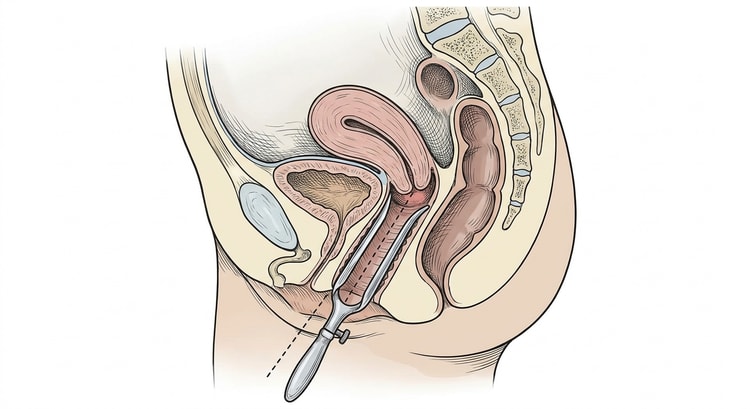
- Ask the patient to let the knees and hips fall outwards.
- Warm the speculum and lubricate it sparingly. A gentle digital examination first can locate the cervix and make insertion more comfortable.
- Separate the labia minora and insert the speculum with the blades almost vertical (1 and 7 o'clock) to avoid pressure on the urethra.
- Insert fully, rotate to the horizontal and open the blades slowly.
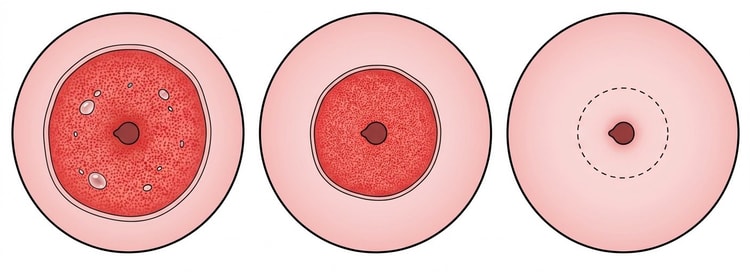
- If you do not see the whole cervix: withdraw the speculum slightly with the blades open until the cervix comes into view. Other manoeuvres are to angle more posteriorly, raise the pelvis on a pillow, ask the patient to hyperflex her hips, or change the size or the model.
- Document the colour, size and position of the cervix, ectopy, polyps, ulceration, lesions and contact bleeding, and the colour, consistency, quantity and odour of any discharge.
The smear
The sample is taken before acetic acid is applied and before any biopsy.
- Do not wipe away mucus with vigorous swabbing — it takes the cells with it.
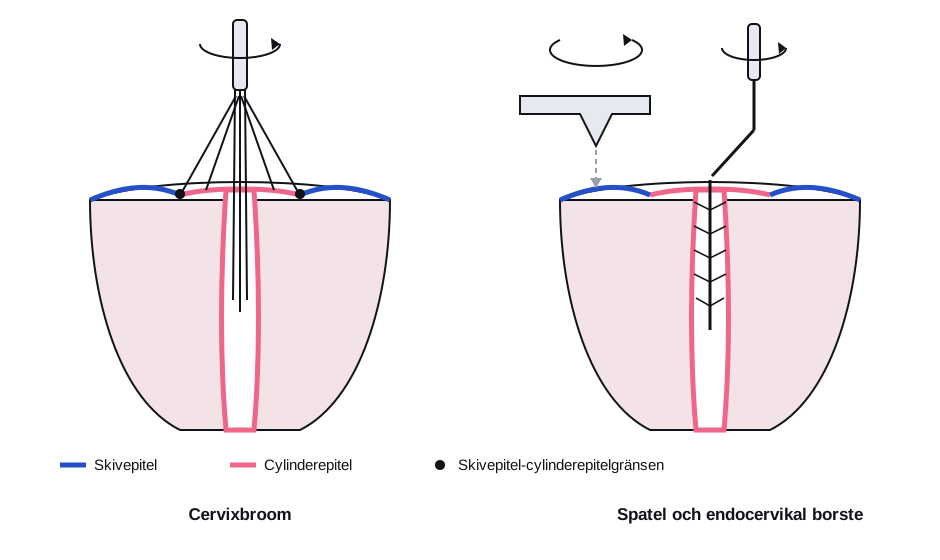
- Introduce the central bristles of the cervical broom into the cervical canal so that the outer bristles lie against the ectocervix.
- Rotate five turns in the same direction.
- Rinse the broom into the liquid-based medium according to the manufacturer's instructions, or break off the head into the vial.
- Aim to include the transformation zone — that is where dysplasia arises. In postmenopausal women it often lies drawn up into the canal and requires an endocervical brush.
- Label the vial and the request form with the correct identity, the date of the last menstrual period, hormone treatment, pregnancy, an intrauterine device, previous abnormal samples and any conisation.
Bimanual and rectovaginal palpation
Introduce the index and middle fingers into the vagina below the cervix. Place the other hand above the symphysis and press gently downwards. Assess the size of the uterus (normally about 7 × 5 × 3 cm), its position, consistency and mobility, and the adnexa for masses and tenderness. Cervical motion tenderness suggests salpingitis.
Rectovaginal palpation — index finger in the vagina, middle finger in the rectum — assesses the rectovaginal septum and can reveal masses in the pouch of Douglas.
Complications
- Discomfort and pain; contact bleeding from the cervix after sampling is common and harmless.
- Vasovagal reaction.
- Retraumatisation in a patient with a history of abuse.
- Mucosal injury from a speculum that is too large or too dry.
- Rarely: ascending infection after instrumentation.
Aftercare and follow-up
Explain that slight bleeding for a couple of days is expected after a smear. Explain how and when the result will come and what happens if the findings are abnormal.
flowchart TD
  A[Smear taken in liquid-based medium] --> B{HPV test}
  B -- Negative --> C[New sample according to the screening interval]
  B -- Positive --> D[Reflex cytology on the same sample]
  D -- Normal cytology --> E[Follow-up sample according to the surveillance schedule of the care programme]
  E --> F{Persistent HPV?}
  F -- No --> C
  F -- Yes --> G[Referral for colposcopy]
  D -- ASCUS or LSIL --> H[Management by age according to the care programme]
  H --> G
  D -- HSIL, AGC or suspected cancer --> G
  I[Visible cervical lesion at the examination] --> J[Referral irrespective of the test result]
K[Postmenopausal bleeding] --> L[Referral for endometrial assessment irrespective of the test result]| Finding | Management |
|---|---|
| HPV-negative sample | New sample according to the screening interval — 5 years up to and including age 49, 7 years thereafter |
| HPV-positive with normal cytology | Follow-up sample according to the surveillance schedule of the care programme; persistent HPV leads to colposcopy |
| HPV-positive with abnormal cytology (ASCUS, LSIL, HSIL, AGC) | Referral for colposcopy; in ASCUS and LSIL the management is governed by age |
| A visible cervical lesion | Referral irrespective of the cytology result — a normal smear does not exclude cancer |
| Postmenopausal bleeding | Referral for endometrial assessment irrespective of the smear result |
Common pitfalls
- Trusting a normal smear when there is a visible lesion. A macroscopically suspicious cervix must be referred, full stop.
- The transformation zone missed — the sample has formally been taken but is diagnostically worthless. In postmenopausal women the junction lies inside the canal and requires an endocervical brush.
- Vigorous cleaning before sampling removes precisely the cells that are to be analysed.
- Too much lubricant interferes with microbiological analyses.
- A full bladder during bimanual palpation and assessment of prolapse.
- A speculum inserted horizontally presses on the urethra and causes unnecessary pain.
- Digital examination in bleeding in late pregnancy before the position of the placenta is known.
- No information between the steps. Consent to the examination is not consent to every part of it.